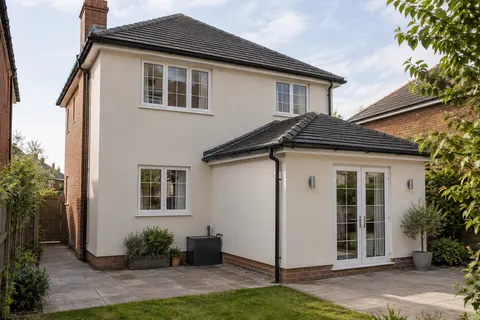
A new colour on a sound exterior
Render Respray Warrington | Colour Changes and Preparation
Changing the colour of an existing rendered wall can transform its appearance without replacing every layer. The important qualification is that the retained covering must be suitable for the proposed treatment. A respray quotation should describe preparation and repairs as clearly as the final colour. In Warrington, our approach to explaining this service separates a decorative change from repair work, so a fresh surface does not conceal an unresolved defect.

On this page
Start with the surface already on the wall
The coating applied years ago may be more relevant than the render beneath it. Several layers of paint, a powdery surface, peeling patches or a previous water-repellent treatment can affect adhesion. The contractor needs enough information to identify the covering or establish a suitable preparation and compatibility test. An attractive colour chart cannot answer those questions. If the old finish is weak, applying a strong new layer over it merely leaves the new appearance dependent on material that was already failing.
Cleaning also needs to suit the wall. Dirt, biological growth and loose paint are different conditions, and an aggressive treatment that removes them quickly may damage the surface. Delicate textures, older coatings and insulated render systems require particular care. The work should follow the selected system manufacturer's preparation guidance, with the wash water and surrounding surfaces considered. A colour-change project is not an invitation to use the highest pressure available. Where cleaning exposes cracks or friable patches, those findings need to feed into the repair scope before decoration continues.
- Clean Washed down, with algae and mould treated and left to work.
- Repair first Cracks and hollow patches are repaired before any coating.
- Prime or stabilise Where the coating maker requires it on that surface.
- Coating Usually two coats of a breathable masonry or silicone coating.
The usual order of work. The survey and the chosen products decide the actual steps.
Separate the repair allowance from the decorative work
Some recolouring projects need very little repair; others reveal that the old colour was not the main problem. Hollow render, broken edges, failed junctions and open cracks require their own treatment. The quote should distinguish between identified repairs, an allowance for findings after cleaning and the coating of sound retained areas. This makes different proposals easier to compare and provides a straightforward way to agree changes. It also avoids treating every extra patch as though it were already included in a loosely described respray.
Repairs can affect the final appearance even when they are technically appropriate. Fresh material may have a different grain or absorbency from its surroundings. The preparation and primer need to account for that variation, but a thin coating will not flatten a rough patch or correct an uneven wall. Our render repair guide discusses matching those physical features. If the objective is a different texture as well as a different colour, compare the proposed treatment with a suitable new silicone finish rather than assuming paint alone can deliver both.
| What you want | What the proposal needs to establish |
|---|---|
| A new colour on sound render | Compatibility, cleaning, preparation and the coating system |
| A consistent appearance after patch repairs | Repair texture and absorbency as well as the decorative treatment |
| A smoother or different surface | Whether an additional render build-up is appropriate; colour alone will not reshape it |
| A remedy for widespread failure | The underlying repair or replacement work before considering appearance |
Test the actual colour on the actual elevation
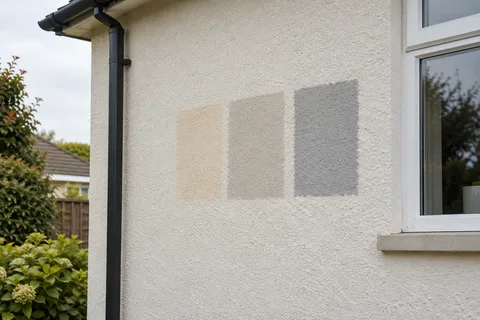
A small printed swatch is useful for narrowing choices, but it does not reproduce a full wall outdoors. The orientation of the elevation, nearby brick, roof tiles, paving and window frames all influence how the colour reads. Compare a properly prepared sample in ordinary daylight and shade, with the intended texture underneath it. If two adjacent elevations receive light differently, it is worth viewing both before final approval. A white that looks soft beside one material can appear much cooler beside another.
Agree the boundaries of the colour change at the same time. Downpipes, meter boxes, sill undersides, recessed panels and the returns into openings can otherwise become ambiguous. Some fittings should be removed and refitted; others need careful protection. The treatment of junctions and sealants must remain appropriate to the materials involved. A sample and a marked elevation are more useful here than a broad instruction to make everything match. They also help distinguish a deliberate colour break from an area missed during application.
Spraying is an application method, not a different wall system
Spray application may suit some coatings and sites, while brush or roller application may be required for other details. The product's instructions, access, surrounding property and the ability to control overspray all matter. Nearby vehicles, gardens, neighbouring windows and pedestrian routes need practical protection. The proposed method should explain how the work can proceed without spreading material beyond the intended surface. A narrow passage or a busy entrance may require a different arrangement from an open rear elevation.
Weather protection and drying conditions remain relevant whichever method is used. A coating must be applied within its specified conditions, and a wall that appears dry on the surface may still need further assessment after prolonged wetting. Timing should allow for preparation, repairs and the necessary intervals between operations. The date on which equipment arrives is therefore not a reliable indication of when every wall can be coated. A clear programme explains the dependencies without promising that weather-sensitive work will continue regardless of conditions.
Keep the maintenance information after the colour has changed
The finished appearance should be checked for coverage, consistent treatment of defined panels and clean adjoining surfaces. Keep the product name, colour reference and preparation record with the property information. Those details help if a pipe is moved later or a small repair becomes necessary. A future contractor should be able to distinguish the original render from the newer decorative coating, rather than make assumptions based on colour alone. Appropriate maintenance also depends on whether the covering is ordinary render or part of an insulated system.
Some existing finishes need a different decision entirely. A traditional wall may require a compatible lime-based repair and finish, while an ageing monocouche surface needs its own manufacturer's advice before decoration. Where the retained material is no longer serviceable, wall replacement may be the relevant route. The Warrington rendering overview explains how these services fit together. Recolouring is most useful when it has a sound surface to work with and a clearly defined visual result.
Common questions
Is a respray the same as re-rendering?
No. Recolouring normally retains the existing render and changes its decorative finish after suitable preparation. Re-rendering involves a new render build-up, potentially with removal and background repairs. Quotes should state which operation they actually include.
Can a coating stop damp coming through a wall?
A colour-change service should not be presented as a diagnosis or cure for damp. Water entry, condensation, defective fittings and unsuitable existing materials need the appropriate assessment. Any decorative treatment follows that assessment rather than replacing it.
See housing and planning information for Warrington and nearby places, including the source and geography behind each figure.