Repairs that address the failed layer
Render Repairs Warrington | Cracks, Loose Areas and Patches
A split beside a window, a loose patch beneath a sill and a network of fine surface cracks can look like variations of the same problem. They may need quite different work. Render repair starts by identifying which layer has failed and whether the cause remains active. A useful repair proposal describes the area being treated, the material being retained and the expected appearance of the finished patch.

On this page
A crack is a symptom, not a specification
The position and pattern matter. A crack through paint alone differs from one continuing through render into masonry; a straight line at the junction of two constructions differs from scattered crazing across a finish. Photographs provide a useful first view, but they cannot show adhesion, concealed layers or continuing movement. Where the condition suggests a structural problem, the appropriate building professional needs to assess it before a decorative repair is agreed. Filling the visible line does not establish that the wall beneath is stable.
Recent changes can explain why a previously serviceable wall now looks different. A replaced window, a leaking downpipe, work to a roof abutment or a new opening may affect the surrounding covering. Include those details in the initial description of the job, along with when the damage appeared and whether it changes after wet weather. The aim is to avoid replacing the same small area repeatedly while water still runs behind it or the junction continues to move. A repair should have a clear reason for being local.
- Map the damage Tapping finds hollow areas; cracks and their likely cause are noted.
- Cut back Failed render is cut out to a sound edge, usually squared off.
- Fix the cause Leaking gutters, sills without drips or render below the DPC are dealt with.
- Rebuild in coats Using a material compatible with the surrounding render and masonry.
- Blend the finish Texture is matched; colour may need a coating over the wider area.
The usual order of work. The survey and the chosen products decide the actual steps.
Define the edge of the repair on sound material
The damaged outline visible from the ground is not necessarily the full repair boundary. A competent inspection may identify surrounding material that has detached from its background, even where its face remains intact. Conversely, an unsightly surface mark does not prove that the whole covering must come off. The preparation allowance should explain how the extent will be established and how any additional removal will be agreed. This is especially important near window heads, corners and narrow piers, where a small extension of the repair can change the detail considerably.
Where the existing construction is older, removal needs care as well as decisiveness. Taking off a hard patch can disturb softer surrounding masonry or useful original material. A compatible lime repair may need a different approach from repairing a modern cement-based render. It is reasonable for a specification to retain sound areas while replacing failed ones, provided the junction and subsequent finish have been considered. Stripping the wall completely is a separate decision, covered in our pebbledash and covering removal guide, rather than an automatic consequence of finding one defect.
| Item | Useful detail |
|---|---|
| Failure | The layer affected and the likely cause requiring attention |
| Extent | A marked area, with an agreed process for concealed damage |
| Background | Cleaning, masonry repairs and preparation before replacement |
| Material | The compatible repair build-up and finishing treatment |
| Appearance | Whether the patch remains visible or an elevation-wide finish follows |
Matching colour is only part of matching a patch
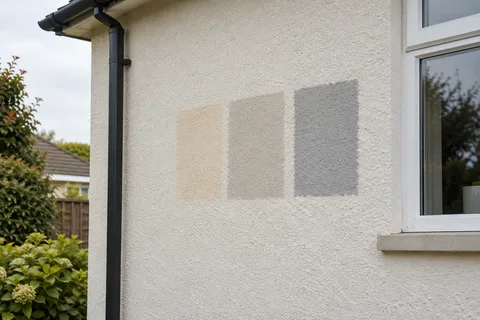
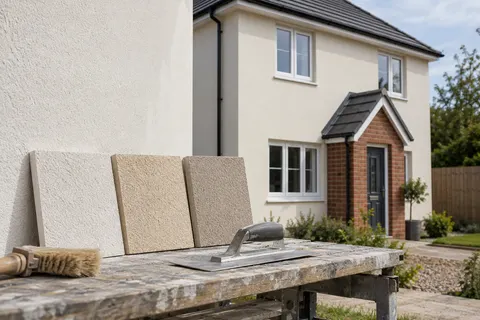
A repair can have the right colour and still stand out because its grain, depth, surface direction or edge profile differs. Light travelling across a wall makes small variations more apparent than a straight-on photograph. Weathered material also has a surface character that a fresh product will not reproduce immediately. For a conspicuous front elevation, a sample can make this compromise clear before the full repair proceeds. The agreed standard should recognise the existing wall rather than imply that every local patch will become invisible.
Sometimes the best result is to repair the damaged areas and apply a suitable finish across a natural architectural panel. That might be the section between two corners or a complete single elevation. It does not mean coating over failures: preparation still comes first, and the selected coating must suit both retained and repaired material. Our render colour-change page explains that distinction. On other buildings, particularly where historic finishes survive, an honest local repair may be preferable to covering everything merely to achieve uniform colour.
Repair the water detail at the same time
Pay attention to the feature above or beside the failure. A sill without an effective projection, a defective gutter connection or a poorly finished penetration can keep wetting the same area. The renderer's scope and the work of other trades need to meet at these points. A vague note saying that plumbing or roofing is excluded leaves a problem if nobody has accepted responsibility for the associated correction. The sequence should allow the cause to be addressed before the new surface is closed up and decorated.
Work at height also changes a seemingly small repair. The safe access needed for inspection, removal, application and return visits can be a substantial part of the operation. Temporary protection must suit the chosen material and the conditions during curing; a quick patch is not necessarily a single-visit job. For repairs beside an entrance, the arrangement should keep people away from the work without unnecessarily blocking the only route into the building. These practical details belong in the proposal, even when the area of render is modest.
Decide what the finished job includes
Before work begins, identify whether decoration, refitting pipes, cleaning adjacent glass and making good access-related disturbances are included. After completion, inspect the repair from normal viewing positions and look closely at the edges and adjoining fittings while access remains available. A record of the material and colour helps with later maintenance. It is also useful to know which original areas were retained, because a future defect elsewhere should not be confused with failure of the new patch.
Local repairs can be a sensible part of maintaining a building, but they have limits. A wall with widespread detachment, repeated incompatible patches or unresolved background problems may need a broader wall-rendering specification. When several elevations are involved, the whole-house guide helps separate urgent repairs from an optional change of appearance. The Warrington homepage brings these routes together so the proposed work can be considered as part of the exterior, without assuming that the largest intervention is always the right one.
Common questions
Can every crack simply be filled and painted?
No. The appropriate treatment depends on the depth, cause and condition of the surrounding material. A surface coating cannot stabilise loose render or resolve movement in the wall. Some cracks need investigation before a repair material can sensibly be chosen.
Will the repaired patch be invisible?
That cannot be promised. Texture, ageing, colour and the way light falls across the wall all affect the result. Agree a sample or a realistic visual standard, including whether a compatible finish across a wider panel is part of the work.
See housing and planning information for Warrington and nearby places, including the source and geography behind each figure.